What Makes a Treadmill Good?
Last updated September 2026
A good treadmill is one where nothing about the machine is the limiting factor. The motor is not straining at the speed you run. The deck is long enough that you are not shortening your stride to stay on it. The frame stays still when you land. And the software gives you a reason to come back, because a machine that clears every mechanical bar and still bores you has failed at the only job that matters.
That sounds obvious, and yet most treadmill comparisons rank machines by numbers without saying what the numbers have to clear. This page does the opposite. It sets the bar first, explains where each threshold comes from, and only then shows which Aviron machine sits where.
Key Takeaways
- Continuous horsepower (CHP) is the only motor number worth reading. Peak horsepower is a marketing figure the machine cannot sustain.
- For walking, 2.5 CHP is enough. For regular running, 3.0 CHP is the floor and 3.5 CHP or more means the motor is not your limit.
- Deck width is a safety spec. 20 inches works, 22 inches means tired feet do not drift toward the rails.
- Deck length follows stride. 55 inches covers walking, 60 inches is the line for running, and taller or faster runners want every inch past that.
- Running puts roughly two to three times your bodyweight through each footfall. Cushioning is the spec that decides how many days a week you can do that.
- Weight capacity is a frame rigidity spec, not a judgment about you. A frame rated well above your weight simply flexes less.
- Warranty length on the frame and drive motor is the closest thing to an honest signal of what a manufacturer expects from its own build.
- None of it matters if you stop getting on the machine, which is why content is a hardware-level consideration and not an accessory.
Four Criteria for Evaluating Whether a Treadmill Is Good
Does the motor have headroom, or is it working at its limit?
Treadmill motors are rated two ways and only one of them means anything. Peak horsepower is the maximum the motor can produce for a moment. Continuous horsepower, written CHP, is what it can sustain indefinitely, which is the number that describes running for 40 minutes. A spec sheet that advertises peak HP and hides CHP is telling you something.
Headroom matters because a motor running near its ceiling runs hot, and heat is what kills treadmill motors. A 3.5 CHP motor asked to do a 2.5 CHP job will outlast a 2.5 CHP motor doing the same work, every time. That is the whole argument for buying more motor than today's workout needs.
Aviron's Justice uses a 3.5 CHP brushless motor. The Podium and Summit use 4.5 CHP commercial brushless motors. Brushless matters for the same reason: fewer wearing parts, less heat, less maintenance.
Is the deck big enough for how you actually move?
Stride length grows as pace increases. That is why a deck that feels generous at a walk can feel short at a run, and why the honest way to size a deck is against your fastest intended pace rather than your average one.
Length: 55 inches is fine for walking. 60 inches is the working threshold for running, and anyone over about six feet who runs at pace should treat 60 as a minimum rather than a target. Width: 20 inches is workable, but on a long run the last few minutes are when your feet wander, and 22 inches is the difference between a correction and a stumble.
Aviron's Justice deck is 20 by 59 inches, sized for walking and steady running. The Podium is 22 by 60. The Summit is 22 by 61, the largest in the lineup.
Does the cushioning do anything measurable?
Running generates a ground reaction force of roughly two to three times bodyweight on every footfall, and a 30-minute run is a few thousand of them. A deck that absorbs some of that is the single reason people can run more days per week indoors than they can on pavement.
The thing to look for is a cushioning system with discrete, replaceable shock elements rather than a deck that is simply described as soft. Aviron uses CloudStride, eight shock absorbers mounted under the deck, upgraded to CloudStride MAX on the Podium and Max CloudStride with eight XL shocks on the Summit.
One caveat worth stating plainly: a softer deck is not automatically better. Too much give costs you push-off efficiency and can feel unstable at speed. What you want is absorption at impact and firmness at toe-off, which is what a multi-shock system is trying to deliver.
Is it built to stay still and keep working?
Weight capacity is widely misread as a statement about the user. It is really a statement about frame rigidity. A frame rated to 350 lb flexes less under a 180 lb runner than a frame rated to 250 lb does, and that stability is what you feel as solidity underfoot.
The other durability signal is the warranty, specifically on the frame and the drive motor, because those are the two components not worth repairing if they fail. Read those two lines and ignore the rest of the coverage table. Aviron covers frame and treadmill drive motor for 10 years as standard, extending to 20 years if you buy direct, keep an active membership and activate it within 90 days of purchase.
The Numbers a Treadmill Has to Clear
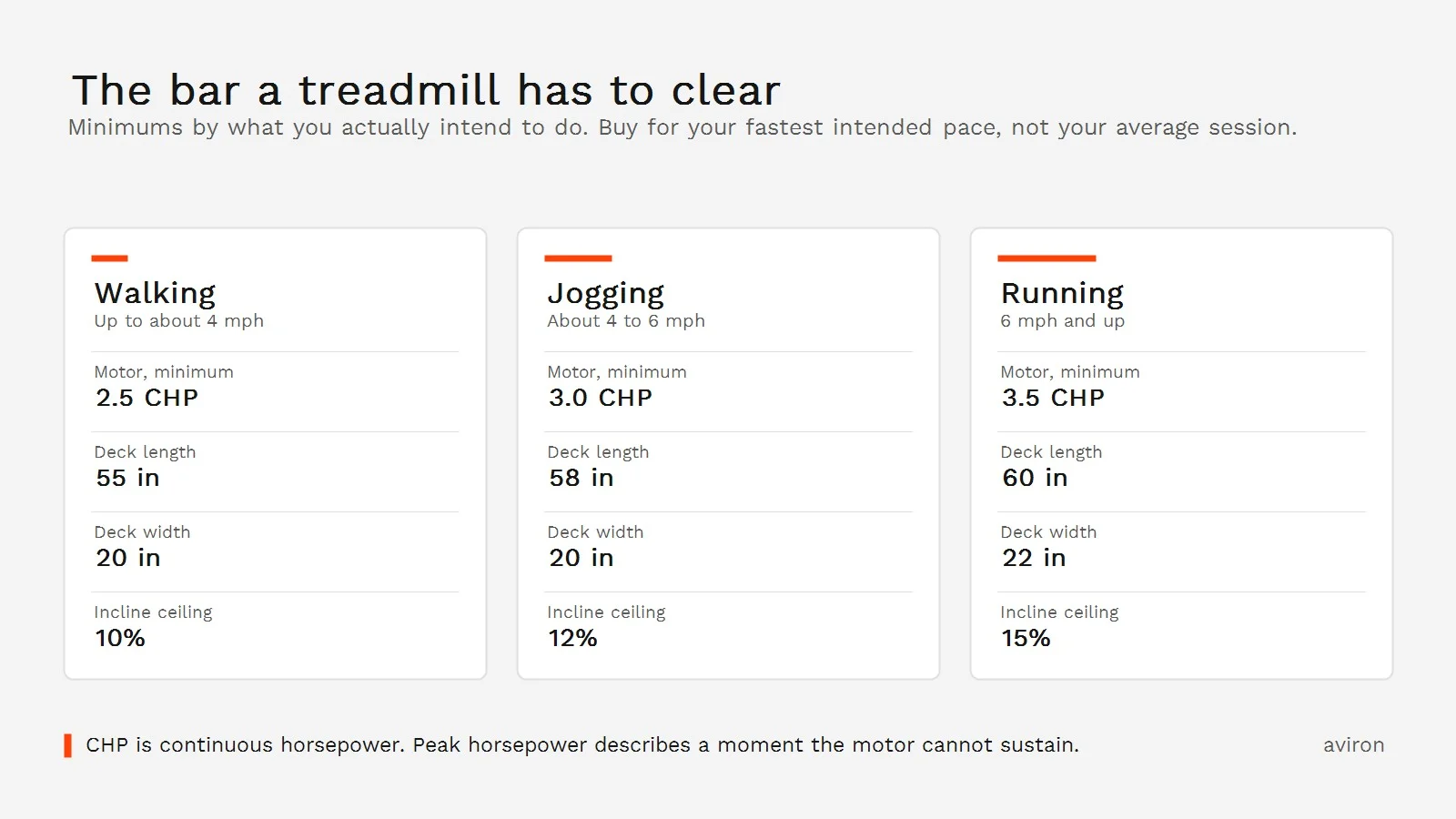
Buy for the fastest thing you seriously intend to do, not for your average session. The cost of overbuying is some money. The cost of underbuying is a machine that becomes a ceiling in about a year, which is how walking pads end up replaced rather than kept.
What Many Buyers Get Wrong
Reading peak horsepower as motor power
A machine advertised at 4.0 peak HP may be a 2.0 CHP machine. If a listing gives you only a peak figure, treat the continuous rating as unknown and ask. This is the single most common way treadmill shoppers overestimate what they are buying.
Treating top speed as a meaningful difference
A 12 mph treadmill runs a five-minute mile. Almost nobody trains at that pace indoors, and the people who do already know it. The gap between a 12 mph and a 14 mph machine matters far less than the gap between a 2.5 and a 3.5 CHP motor, because you will feel the motor on every run and the top speed on none of them.
Assuming a bigger screen means more content
Screen size and library size are unrelated specs that get sold together. A 27-inch panel showing one workout format is a worse purchase than a 16-inch panel with games, coached classes, scenic routes, training programs, multiplayer and built-in streaming. Decide what you want to watch first, then decide how big you want it. We went into this in why the screen matters as much as the motor.
Buying the smallest machine that fits
Compact is a real requirement and a walking pad can be the right answer. But most walking pads cap out near 4 mph with little or no incline, so the day your training changes, the machine cannot come with you. A folding treadmill with full specs solves the space problem without building in the ceiling. That is the entire argument for the Justice over a walking pad, and we compared them directly in walking pad vs treadmill.
Treating content as an accessory
The most common failure mode for a home treadmill is not mechanical. It is that the owner stopped getting on it. Any evaluation framework that scores motors and decks but treats the software as a bonus is measuring the wrong thing, because the machine that gets used ten times a month beats the better machine that gets used twice.
How Do You Know if a Treadmill Will Be Used Consistently?
You cannot know for certain, but you can screen for the things that reliably predict it. Four questions, all answerable before you buy:
- Is there something on it you would choose on its own merits? Not something you would tolerate. Something you would pick. If the honest answer is no, the specs will not save it.
- How many steps between deciding and moving? Unfolding, waking a screen, logging someone out, choosing. Every one is a place to quit.
- Does it stay out of the way when it is not in use? A machine that blocks a room generates resentment from everyone who lives there, including you.
- What happens if you stop subscribing? If the machine becomes a rack the day you cancel, that is a risk you are carrying for the whole ownership period.
Aviron's answers, in order: a library of over 1,000 programs across eight categories updated every four to six weeks; unlimited profiles so nobody logs anyone out and streaming apps built in rather than cast from a phone; folding on the Justice and Podium; and a machine that still records metrics-only workouts, keeps your profile, badges and friends, and runs Netflix, Hulu, Disney+, YouTube and Spotify with no membership at all. Workouts done while streaming are not recorded, but nothing gets bricked.
Why Aviron Stands Out
Aviron's position on this is that engagement is an engineering problem, not a marketing one. The platform builds game psychology into every workout type rather than bolting a leaderboard onto one. There is no handset. Your pace and your incline are the controller, so pushing harder is what makes something happen on screen, whether that is closing on a runner ahead of you or banking a bonus for holding a pace.
That sits alongside coached classes, scenic destinations, training programs and live multiplayer, which is why the library spans eight categories instead of one. Across the platform it shows up as 92% one-year retention among more than 50,000 members, over 4 million workouts completed, and an average rating of 4.8 to 4.9 stars.
"Interactive and engaging. Workout is over seemingly before it even starts." Tom Lindros, verified Aviron buyer
On the hardware side, all three machines clear the running thresholds above, and the membership is $29 per month billed annually or $34 monthly with unlimited profiles.
Best Aviron Treadmill for Runners
The Podium. It is the machine that clears every threshold on this page with room to spare: a 4.5 CHP commercial brushless motor, 14 mph top speed, a 22 by 60 inch CloudStride MAX deck with eight shock absorbers, 350 lb capacity and 0 to 18% incline. It also runs at roughly 70 dB at maximum speed, which is around the level of normal conversation and matters if anyone else is home.
The part that makes it unusual is that it still folds. SafeLift pneumatic assist takes it from 80 inches long to 49, so you get full running specs without giving up a room permanently. Screen options are 16, 22 or 27 inches.

4.5 CHP, 14 mph, 22 by 60 inch deck, 350 lb capacity, folds to 49 inches.
Best Aviron Treadmill for Walking and Hiking
The Summit, and the reason is incline rather than anything about walking specifically. It runs from a 6% decline to a 42% incline, the widest range in the category, which turns walking into genuinely hard training without asking your joints to absorb faster footfalls. That is the whole appeal of incline walking, and the Summit takes it further than anything else on the market.
Hiking handles carry incline and speed keys plus heart rate sensors, so you can climb hard without letting go to reach a console. The deck is the largest in the lineup at 22 by 61 inches with eight XL shock absorbers, and capacity is 350 lb. The decline half is the part people overlook: descending is what wrecks quads on a real trail, and very few machines train it at all.
The trade-off is stated plainly. It does not fold and it is not WalkDesk compatible, because a frame rigid enough to hold a 42% tilt cannot hinge in the middle. At 67 by 37 by 71 inches it is shorter than the other two but taller, so check your ceiling. For what 42% actually feels like, see how steep a 42% treadmill incline really is.

6% decline to 42% incline, hiking handles with built-in controls, 22 by 61 inch deck.
Best Aviron Treadmill for Small Spaces
The Justice, which is the machine that proves compact does not have to mean compromised. It is 34 inches wide, which clears most doorways, and folds to a 53-inch footprint on a SafeLift pneumatic assist so it stores upright against a wall. Underneath that it is a 3.5 CHP brushless motor, 12.5 mph top speed, 0 to 15% incline and a 20 by 59 inch CloudStride deck with eight shock absorbers, rated to 300 lb.
Measured against the thresholds above, that is a genuine running treadmill in a footprint most people associate with a walking pad. It also takes the WalkDesk, a transparent desk surface that stays level even on an incline with the controls still visible underneath.
The honest trade-off: the 59 inch deck is one inch under the 60 inch guidance for running, and 20 inches is the narrower of the two widths here. If you are tall and run fast, the Podium is the better buy.

34 inches wide, folds to 53 inches, stores upright, and takes the WalkDesk.
Which Treadmill Is Right for You?
| Spec | Justice | Podium | Summit |
|---|---|---|---|
| Built for | Small spaces, walking desks | Running | Incline, hiking, descents |
| Motor | 3.5 CHP brushless | 4.5 CHP brushless | 4.5 CHP brushless |
| Top speed | 12.5 mph | 14 mph | 14 mph (to 15% incline) |
| Incline | 0 to 15% | 0 to 18% | 6% decline to 42% |
| Running deck | 20 x 59 in | 22 x 60 in | 22 x 61 in |
| Cushioning | CloudStride, 8 shocks | CloudStride MAX, 8 shocks | Max CloudStride, 8 XL shocks |
| Weight capacity | 300 lb | 350 lb | 350 lb |
| Folds | Yes, to 53 x 34 x 68 in | Yes, to 49 x 37 x 68 in | No |
| Screen options | 16 or 22 in | 16, 22 or 27 in | 16, 22 or 27 in |
| WalkDesk compatible | Yes | Yes | No |
Frequently Asked Questions
What makes a treadmill good?
A good treadmill is one where nothing about the machine limits what you are trying to do. Practically, that means a continuous horsepower rating with headroom above your intended use, a deck long and wide enough for your stride at your fastest pace, cushioning that measurably reduces impact, a frame rated well above your weight, and software you would actually choose to spend time with.
How much horsepower do I need in a treadmill?
2.5 CHP for walking, 3.0 CHP as the floor for regular running, and 3.5 CHP or more if you want the motor to stop being a consideration. Always read the continuous horsepower figure rather than peak, since peak describes a moment the machine cannot sustain.
How important is deck size?
More important than most specs it gets listed beside. Length should match your stride at your fastest intended pace, which means 55 inches for walking and 60 inches as the working minimum for running. Width is a safety spec: 22 inches gives you room when your feet start to wander late in a run, and 20 inches does not give you much.
Does treadmill cushioning actually protect your joints?
It reduces the impact force your body absorbs on each footfall, which is meaningful when running puts roughly two to three times bodyweight through every step. That is why most people can run more days per week on a cushioned deck than on pavement. It is not a substitute for sensible training volume, and a deck that is too soft costs you efficiency, so what you want is absorption at impact and firmness at push-off.
What does weight capacity really tell me?
Frame rigidity. A higher rating means less flex under load, which you feel as stability. It is generally worth choosing a machine rated well above your weight rather than one you sit just under, regardless of what you weigh.
How much incline do I actually need?
A 12% ceiling covers most training, including the 12-3-30 workout and standard hill intervals. 15% gives you headroom and 18% more again. Go beyond that only if hill or hiking training is a stated goal, which is what the Summit's 42% range and 6% decline exist for.
What if I stop using it?
This is the right question to ask before buying rather than after. Screen for it by checking how much friction stands between deciding to work out and moving, whether the machine can get out of the way, and whether there is content you would choose rather than tolerate. Aviron folds on two of three models, keeps unlimited profiles so nobody has to log anyone out, and updates the library every four to six weeks.
Is the membership worth it, and what happens if I cancel?
Aviron is $29 per month billed annually or $34 monthly, covering unlimited profiles. If you cancel, the machine keeps running: metrics-only workouts are still recorded, your profile, badges and social features stay, and the built-in streaming apps still work. Workouts done through streaming apps are not recorded. Note that the 20-year warranty extension depends on keeping the membership active, so cancelling reverts frame and drive motor coverage to the standard 10 years.
Can I try an Aviron treadmill before committing?
There is a 30-day risk-free home trial on a first-time machine purchase in the contiguous US, returned in original packaging and new condition, which is the reason the setup instructions tell you to keep the box. Justice, Podium and Summit are also carried at Amazon, Dick's Sporting Goods, Best Buy Canada and Johnson Fitness if you want to see one in person first.
How long should a good treadmill last?
Seven to twelve years is reasonable for a well-built home machine, with a belt replacement somewhere in the middle. The frame and the drive motor decide it, since neither is economical to replace. Aviron covers both for 10 years as standard and 20 years on a direct purchase with an active membership activated within 90 days.
Benefits of Buying Direct From Aviron
- The 20-year warranty requires it. Frame and drive motor coverage extends from 10 to 20 years only on a direct purchase with an active membership activated within 90 days.
- 30-day risk-free home trial. First-time machine purchases in the contiguous US, in original packaging and new condition.
- Financing without interest. 0% APR through Affirm, PayPal Pay in 4, and HSA or FSA payment through Truemed in the US at no extra fee.
- White Glove delivery. Scheduled delivery, in-home placement, assembly, power and WiFi setup, and optional packaging removal. Assembly runs about 30 minutes.
- A service discount. One-time discount for military, healthcare workers and first responders.
Explore More
- How to choose the best treadmill for your home gym, applying these criteria to a real room
- Best Treadmills of 2026, our picks by training goal
- Justice, Podium or Summit, which Aviron treadmill is right for you
- Smart treadmill software, why the screen matters as much as the motor
- Walking pad vs treadmill, where the ceiling actually falls
- How steep is a 42% treadmill incline, a real-world grade comparison
Three treadmills, one membership, unlimited profiles, and a 30-day risk-free home trial.
Shop Aviron treadmills →

